
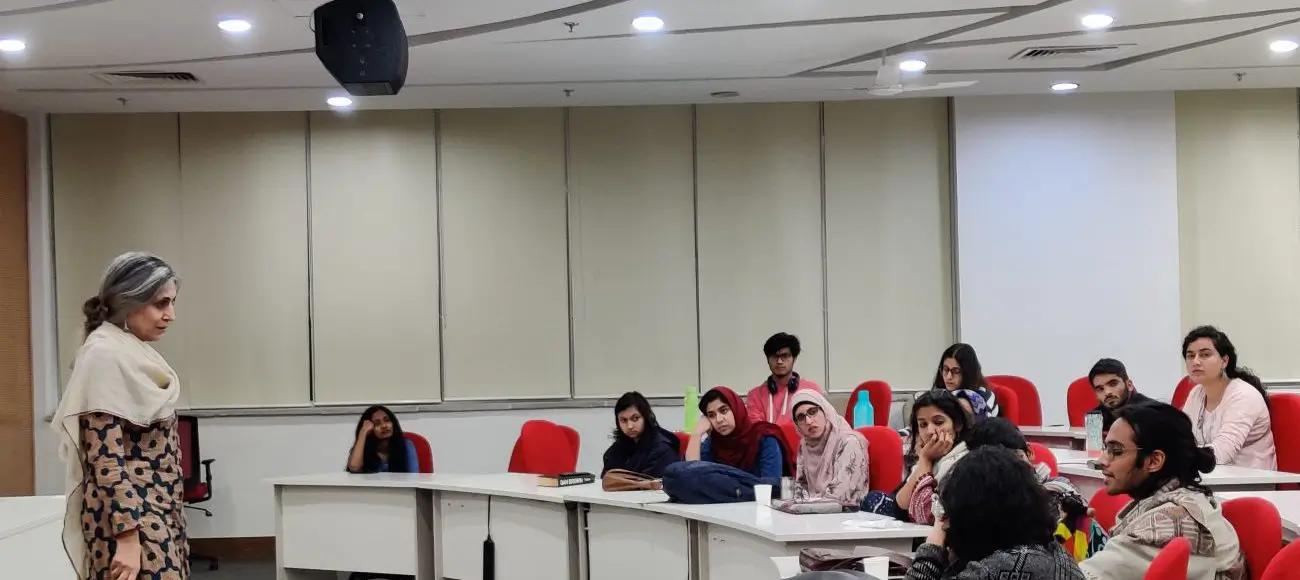
As we approached 200 days since the Indian state abrogated Article 370, continuing decades of violent control over Kashmir, the CSGS held a public reading of selected texts by Kashmiri students on 20th February, Thursday and organized a film screening later in the evening.
The film Khoon Diy Baarav enters the vexed political scenario in Kashmir through the lives of families of the victims of enforced disappearances. The film is a non-sequential account of personal narratives and reminiscences ruptured by violence, undermined by erasure and over-ridden by official documents that challenge truth. Made over nine years it explores memory as a mode of resistance, constantly confronting and morphing – from the personal to political, inpidual to collective. It looks at the ways in which those affected by violence have no choice but to remember.
Iffat Fatima is an independent documentary filmmaker, researcher and audio-visual designer from Kashmir. For many years now, through her documentary work, she has been exploring the overlaps between memory, history and violence. Her documentary film Khoon Diy Baarav (Blood Leaves its Trail 2015), explores issues of violence and memory in Kashmir and Lanka – the other side of war and peace is a journey through the history of overlapping conflicts in Sri Lanka. Read a review of the film here.
Her films include, Where Have You Hidden My New Crescent Moon, The Kesar Saga, In the Realm of the Visual, Boojh Sakey to Boojh. Her installation work Ethnography of a European city: Conversations in Salzburg, questions some of the assumptions in the east vs. west polarity/dichotomy/disparity.